The Power of Many Small Sex Differences in Cognition, Personality, and Interests

Across 13 cognitive tasks and questionnaires (NF = 1465, NM = 1302), small sex differences in the expected directions combined to correctly classify individuals as male or female in 80% of cases and explained a substantial share of variance in real-life occupational gender segregation.
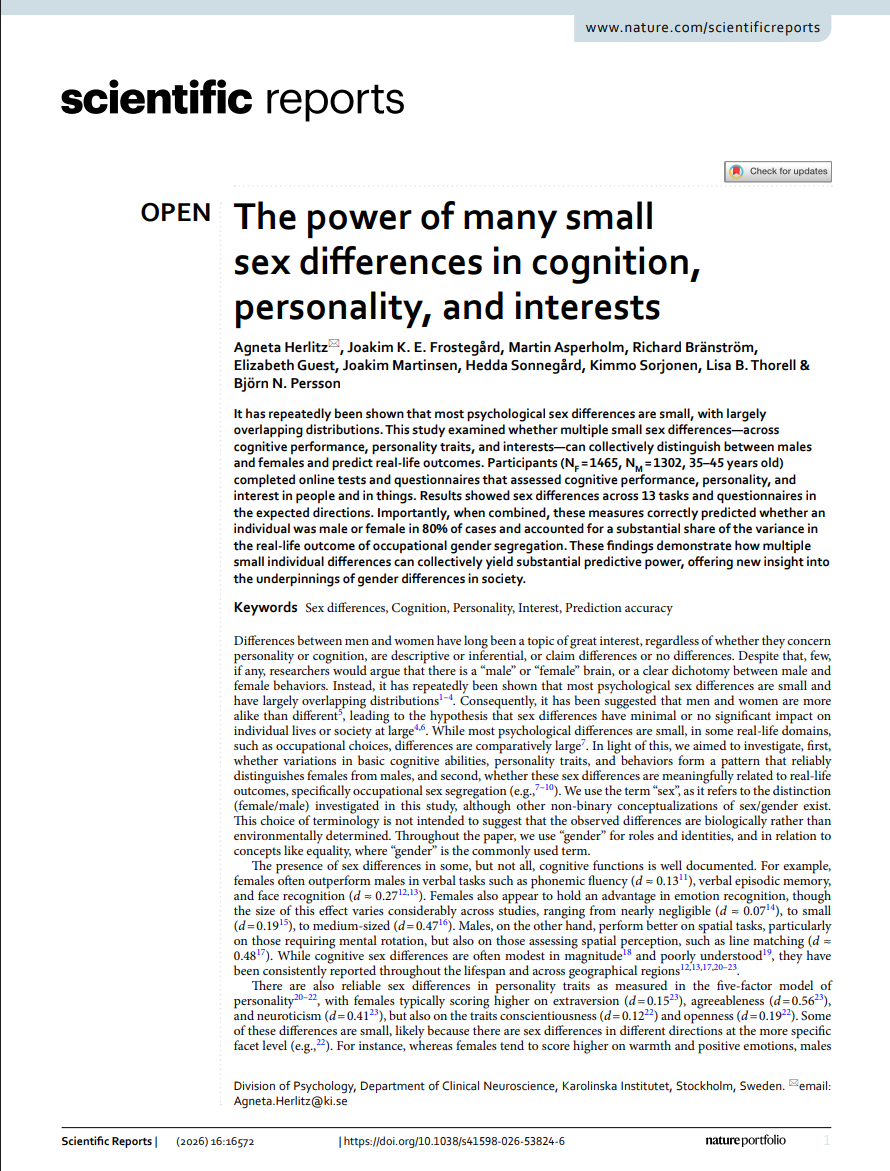
May 2026 · Agneta Herlitz, Joakim K. E. Frostegård, Martin Asperholm, Richard Bränström, Elizabeth Guest, Joakim Martinsen, Hedda Sonnegård, Kimmo Sorjonen, Lisa B. Thorell, Björn N. Persson
Paper preview

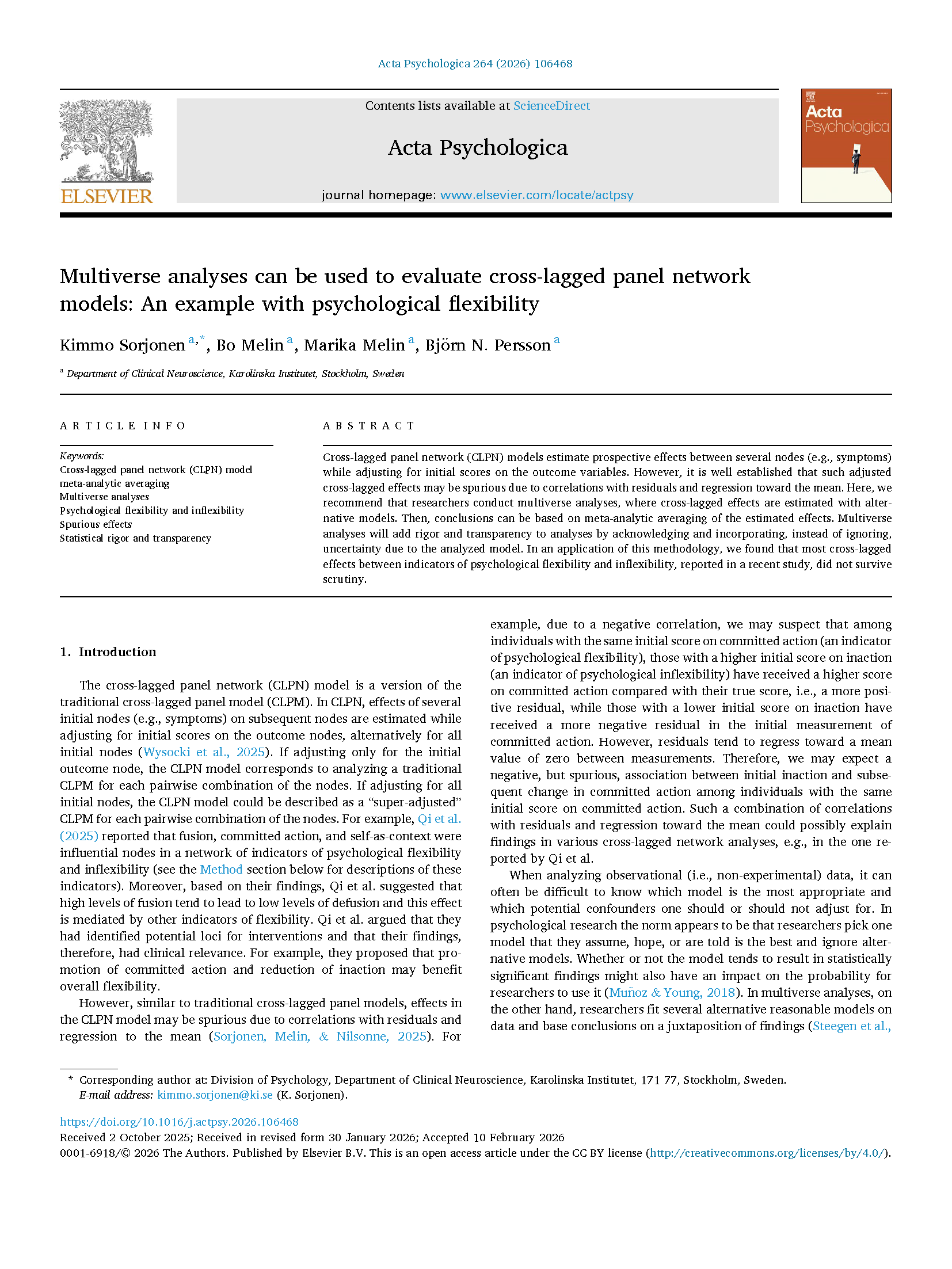
Multiverse Analyses Can Be Used to Evaluate Cross-Lagged Panel Network Models: An Example with Psychological Flexibility

We recommend that researchers conducting cross-lagged panel network (CLPN) analyses use multiverse analyses, where cross-lagged effects are estimated with alternative models and conclusions are based on meta-analytic averaging. Applied to psychological flexibility data, most previously reported cross-lagged effects did not survive scrutiny across alternative model specifications.

February 2026 · Kimmo Sorjonen, Bo Melin, Marika Melin, Björn N. Persson
Paper preview

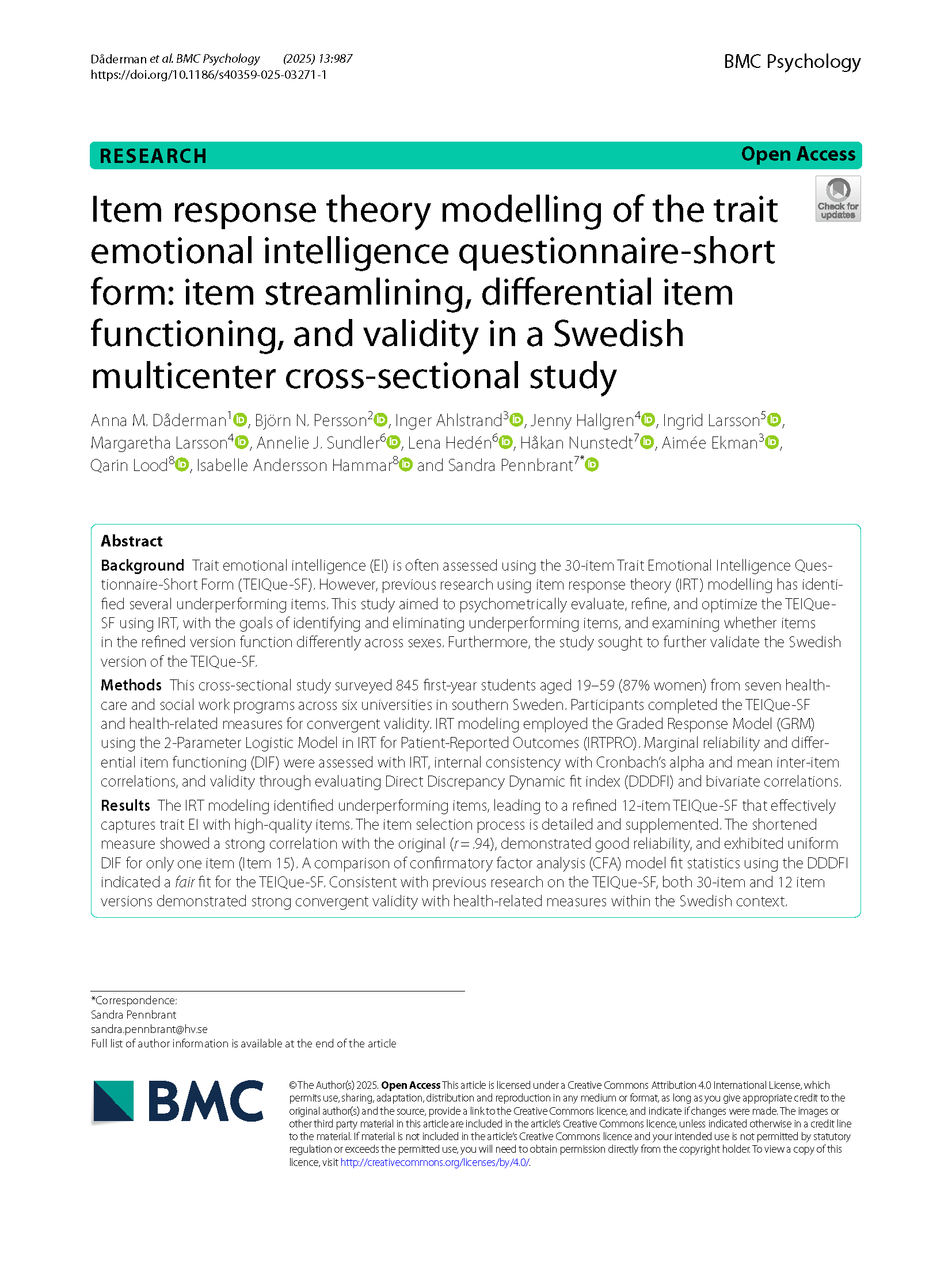
Item Response Theory Modelling of the Trait Emotional Intelligence Questionnaire-Short Form: Item Streamlining, Differential Item Functioning, and Validity in a Swedish Multicenter Cross-Sectional Study

We applied IRT to evaluate and refine the 30-item Trait Emotional Intelligence Questionnaire-Short Form (TEIQue-SF) in a Swedish sample of 845 healthcare and social work students. IRT identified underperforming items, yielding a refined 12-item version that effectively captures trait EI with good reliability and strong convergent validity.

August 2025 · Anna M. Dåderman, Björn N. Persson, Inger Ahlstrand, Jenny Hallgren, Ingrid Larsson, Margaretha Larsson, Annelie J. Sundler, Lena Hedén, Håkan Nunstedt, Aimée Ekman, Qarin Lood, Isabelle Andersson Hammar, Sandra Pennbrant
Paper preview

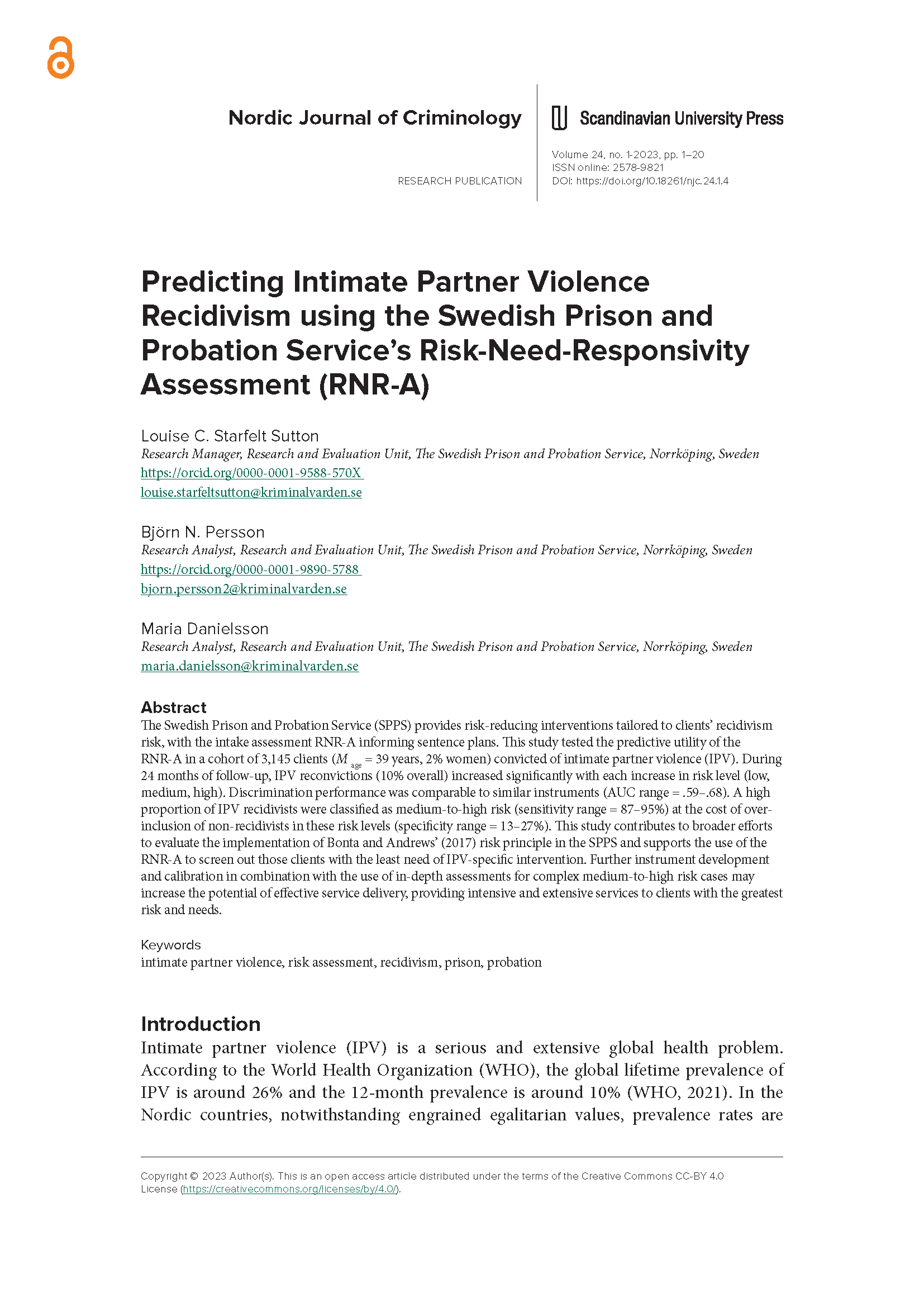
Predicting Intimate Partner Violence Recidivism Using the Swedish Prison and Probation Service's Risk-Need-Responsivity Assessment (RNR-A)

We tested the RNR-A’s predictive utility for IPV recidivism in a cohort of 3,145 clients. IPV reconvictions (10% over 24 months) increased with risk level. Discrimination was comparable to similar instruments (AUC .59–.68). The tool showed high sensitivity but low specificity, supporting its use as a screening tool.

February 2023 · Louise C. Starfelt Sutton, Björn N. Persson, Maria Danielsson
Paper preview

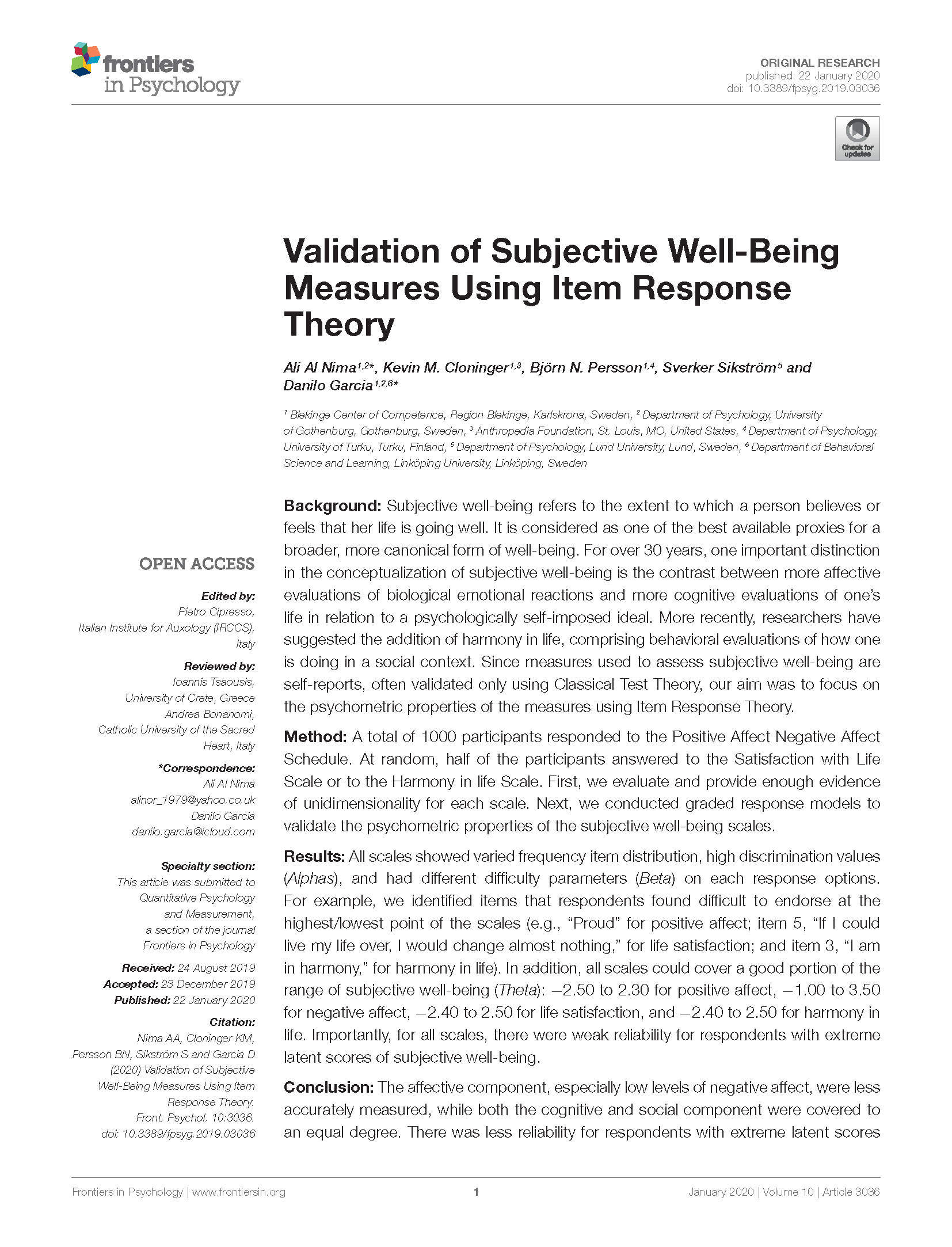
Validation of Subjective Well-Being Measures Using Item Response Theory

We applied IRT to validate three subjective well-being scales in a sample of 1,000 participants. All scales showed high item discrimination values and varied difficulty parameters. Negative affect and extreme latent scores were less reliably measured, while cognitive and social well-being components were covered equally well.

January 2020 · Ali Al Nima, Kevin M. Cloninger, Björn N. Persson, Sverker Sikström, Danilo Garcia
Paper preview

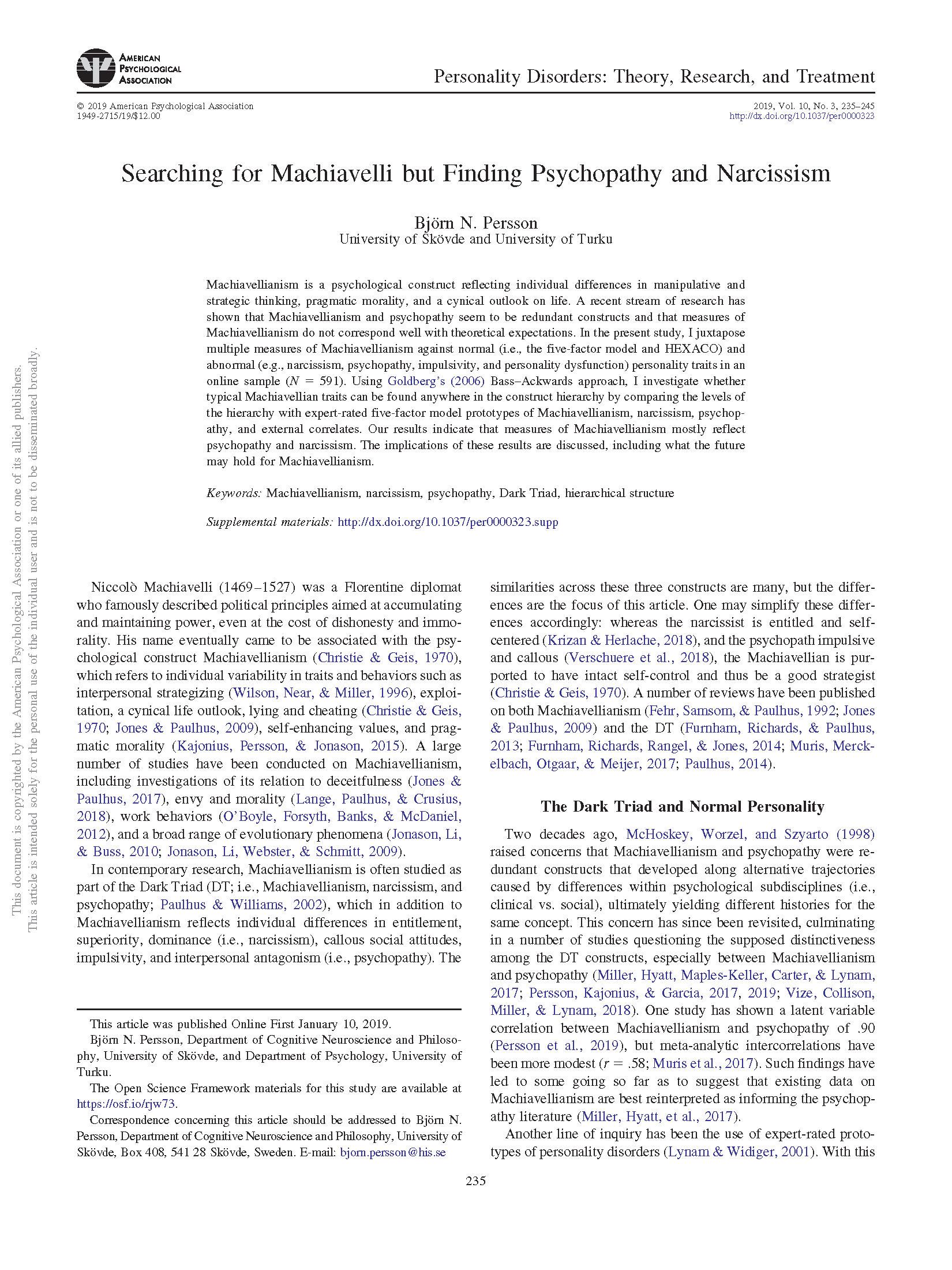
Searching for Machiavelli but Finding Psychopathy and Narcissism

Using Goldberg’s Bass-Ackwards approach in an online sample (N = 591), I examined the hierarchical structure of multiple Machiavellianism measures against normal and abnormal personality traits. Results indicate that measures of Machiavellianism predominantly reflect psychopathy and narcissism, raising questions about the construct’s distinctiveness.

May 2019 · Björn N. Persson
Paper preview

Social Status as One Key Indicator of Successful Psychopathy: An Initial Empirical Investigation

We propose that successful psychopathy is best conceptualized by high social status and low antisocial behavior. In a sample of 591 participants, boldness (an adaptive psychopathy feature) was positively related to socioeconomic status and personality functioning, while disinhibition and meanness were negatively related to both, supporting a two-dimensional view of success.

January 2019 · Björn N. Persson, Scott O. Lilienfeld
Paper preview

Current Directions in Psychiatric Classification: From the DSM to RDoC

This chapter reviews the conceptualization of personality disorders from DSM-III onwards, outlines key differences between the DSM-5 and RDoC perspectives, and describes challenges for the RDoC framework—including a discussion of the network approach to psychological disorders as a possible alternative.

January 2019 · Björn N. Persson
Paper preview

IRT Analyses of the Swedish Dark Triad Dirty Dozen

We applied Item Response Theory to the Swedish Dark Triad Dirty Dozen (N = 570). Contrary to findings on the English version, narcissism provided most information, followed by psychopathy, then Machiavellianism. Psychopathy items required higher latent trait levels for endorsement, possibly reflecting Swedish cultural conditions.

March 2018 · Danilo Garcia, Björn N. Persson, Ali Al Nima, Joel Gruneau Brulin, Max Rapp-Ricciardi, Petri J. Kajonius
Paper preview

Testing Construct Independence in the Short Dark Triad Using Item Response Theory

We analyzed the Short Dark Triad (SD3) in a large sample (N = 1,983) using Item Response Theory. Machiavellianism items showed lower endorsement thresholds than psychopathy items. IRT model fit testing showed that Machiavellianism and narcissism could not be modelled together, while Machiavellianism-psychopathy and narcissism-psychopathy combinations yielded acceptable fit.

May 2017 · Björn N. Persson, Petri J. Kajonius, Danilo Garcia
Paper preview

Revisiting the Structure of the Short Dark Triad

We investigated the SD3’s factor structure in three independent samples using exploratory and confirmatory factor analyses. Machiavellianism and psychopathy items showed large general factor loadings while narcissism loaded more on a specific factor. A bifactor model fit best, and we recommend using the SD3 composite score rather than subscale scores.

April 2017 · Björn N. Persson, Petri J. Kajonius, Danilo Garcia
Paper preview

The Relationship between Mind-Body Dualism and Personal Values

We investigated to what degree Swedish university students’ beliefs in mind-body dualism are explained by personal values. Students holding stronger dualistic beliefs attached less importance to the Power value (social status, dominance), suggesting that value priorities partially explain lay beliefs about the mind-body relationship.

May 2016 · Gunne Grankvist, Petri Kajonius, Björn N. Persson
Paper preview

Empathy and Universal Values Explicated by the Empathy-Altruism Hypothesis

In two studies, we examined whether emotional and cognitive empathy relate differentially to Schwartz’s universal values. Emotional empathy was strongly and positively related to altruistic values and accounted for up to 18% additional variance beyond the Big Five, whereas cognitive empathy did not, consistent with the empathy-altruism hypothesis.

March 2016 · Björn N. Persson, Petri J. Kajonius
Paper preview

The (Mis)measurement of the Dark Triad Dirty Dozen: Exploitation at the Core of the Scale

We replicated the factor structure and item response properties of the Dark Triad Dirty Dozen (DD) in a sample of 3,698. Results confirmed a bi-factor model, but suggest the DD is best understood as a combined Machiavellianism-psychopathy factor, with its core captured by a single exploitativeness item.

March 2016 · Petri J. Kajonius, Björn N. Persson, Patricia Rosenberg, Danilo Garcia
Paper preview

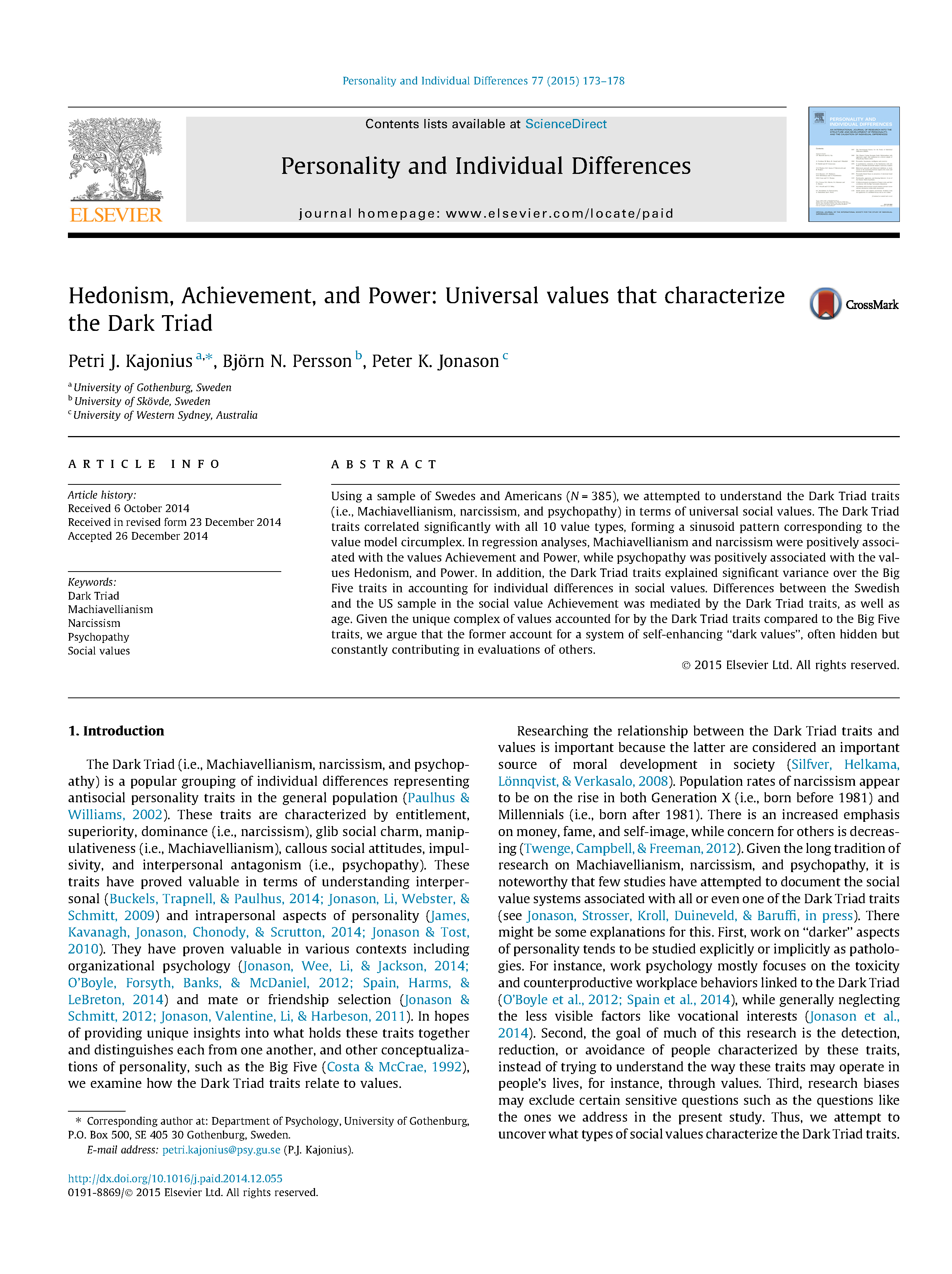
Hedonism, Achievement, and Power: Universal Values That Characterize the Dark Triad

Using a sample of Swedes and Americans (N = 385), we examined how Dark Triad traits relate to Schwartz’s 10 universal value types. Machiavellianism and narcissism were linked to Achievement and Power, and psychopathy to Hedonism and Power. The Dark Triad traits explained unique variance in social values beyond the Big Five.

January 2015 · Petri J. Kajonius, Björn N. Persson, Peter K. Jonason
Paper preview