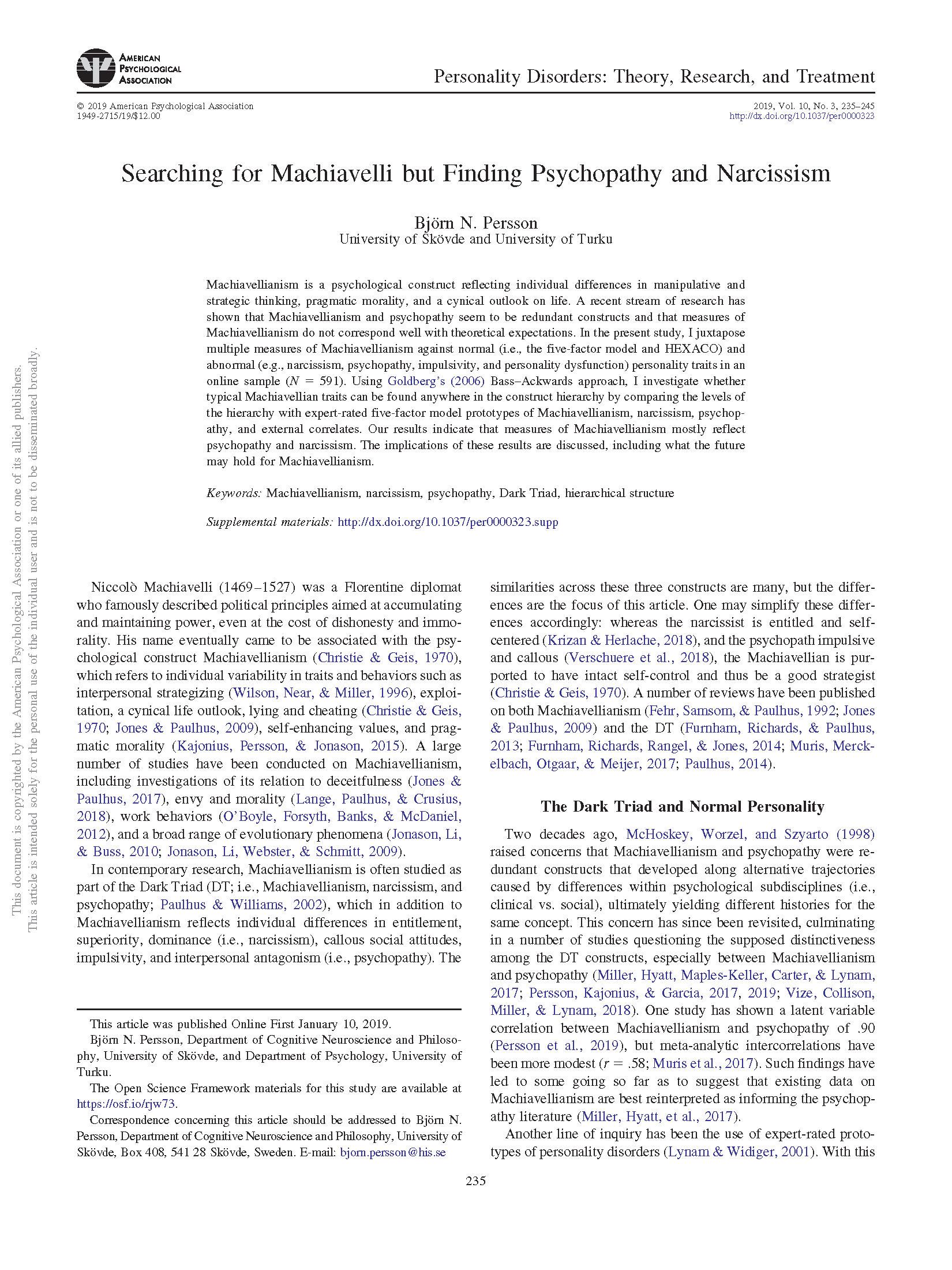
Searching for Machiavelli but Finding Psychopathy and Narcissism

Using Goldberg’s Bass-Ackwards approach in an online sample (N = 591), I examined the hierarchical structure of multiple Machiavellianism measures against normal and abnormal personality traits. Results indicate that measures of Machiavellianism predominantly reflect psychopathy and narcissism, raising questions about the construct’s distinctiveness.
May 2019 · Björn N. Persson
Paper preview

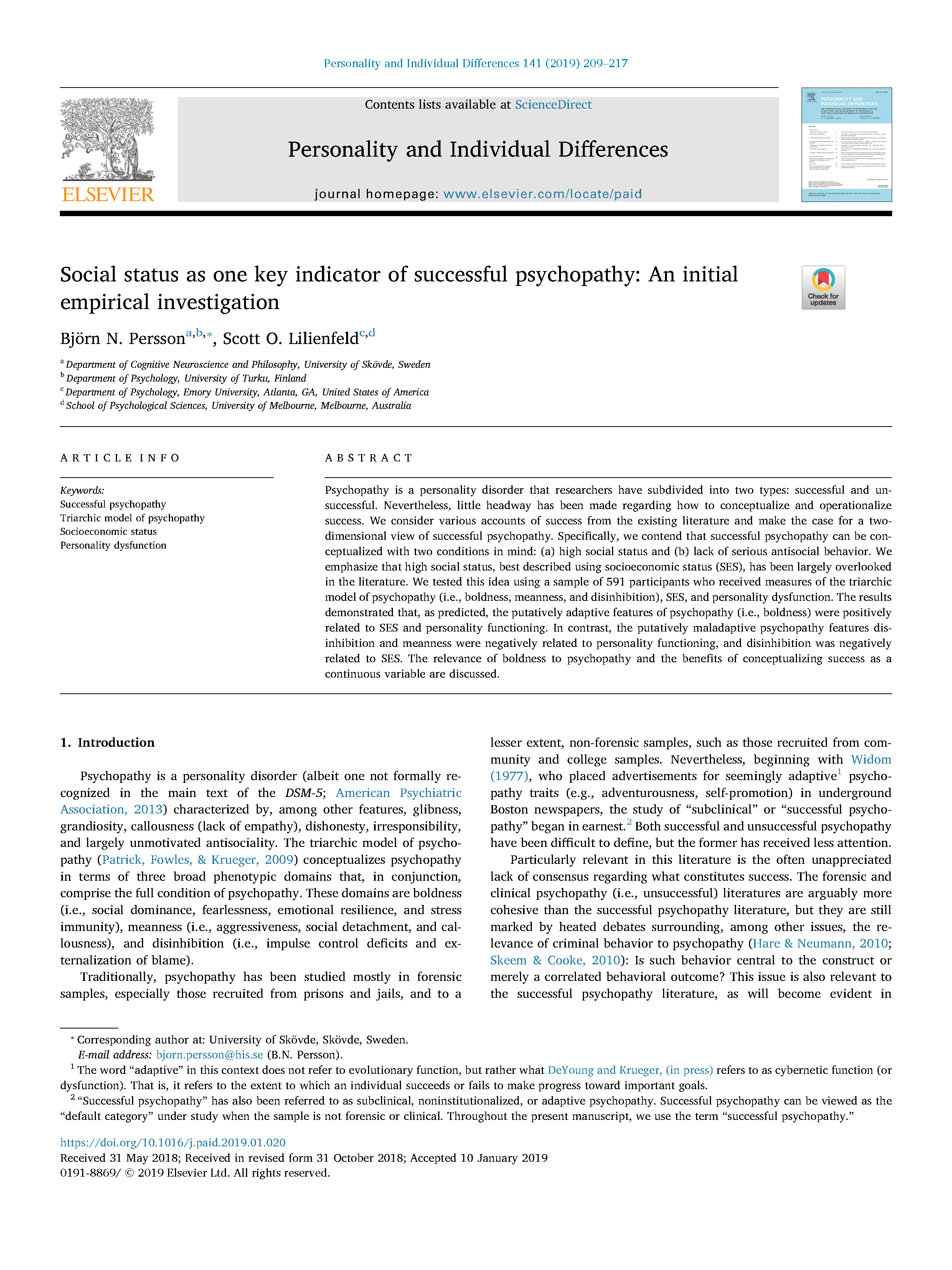
Social Status as One Key Indicator of Successful Psychopathy: An Initial Empirical Investigation

We propose that successful psychopathy is best conceptualized by high social status and low antisocial behavior. In a sample of 591 participants, boldness (an adaptive psychopathy feature) was positively related to socioeconomic status and personality functioning, while disinhibition and meanness were negatively related to both, supporting a two-dimensional view of success.

January 2019 · Björn N. Persson, Scott O. Lilienfeld
Paper preview

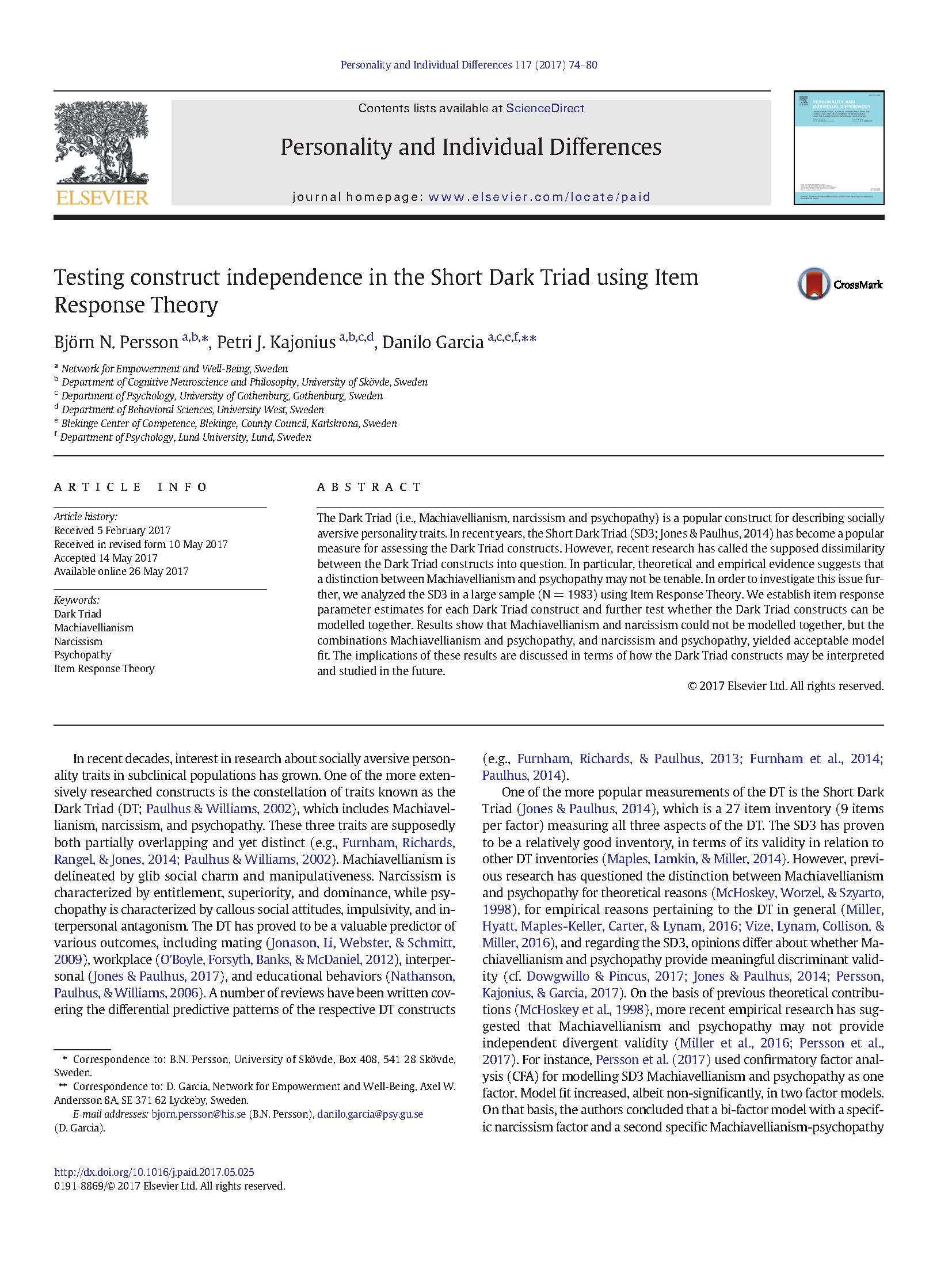
Testing Construct Independence in the Short Dark Triad Using Item Response Theory

We analyzed the Short Dark Triad (SD3) in a large sample (N = 1,983) using Item Response Theory. Machiavellianism items showed lower endorsement thresholds than psychopathy items. IRT model fit testing showed that Machiavellianism and narcissism could not be modelled together, while Machiavellianism-psychopathy and narcissism-psychopathy combinations yielded acceptable fit.

May 2017 · Björn N. Persson, Petri J. Kajonius, Danilo Garcia
Paper preview

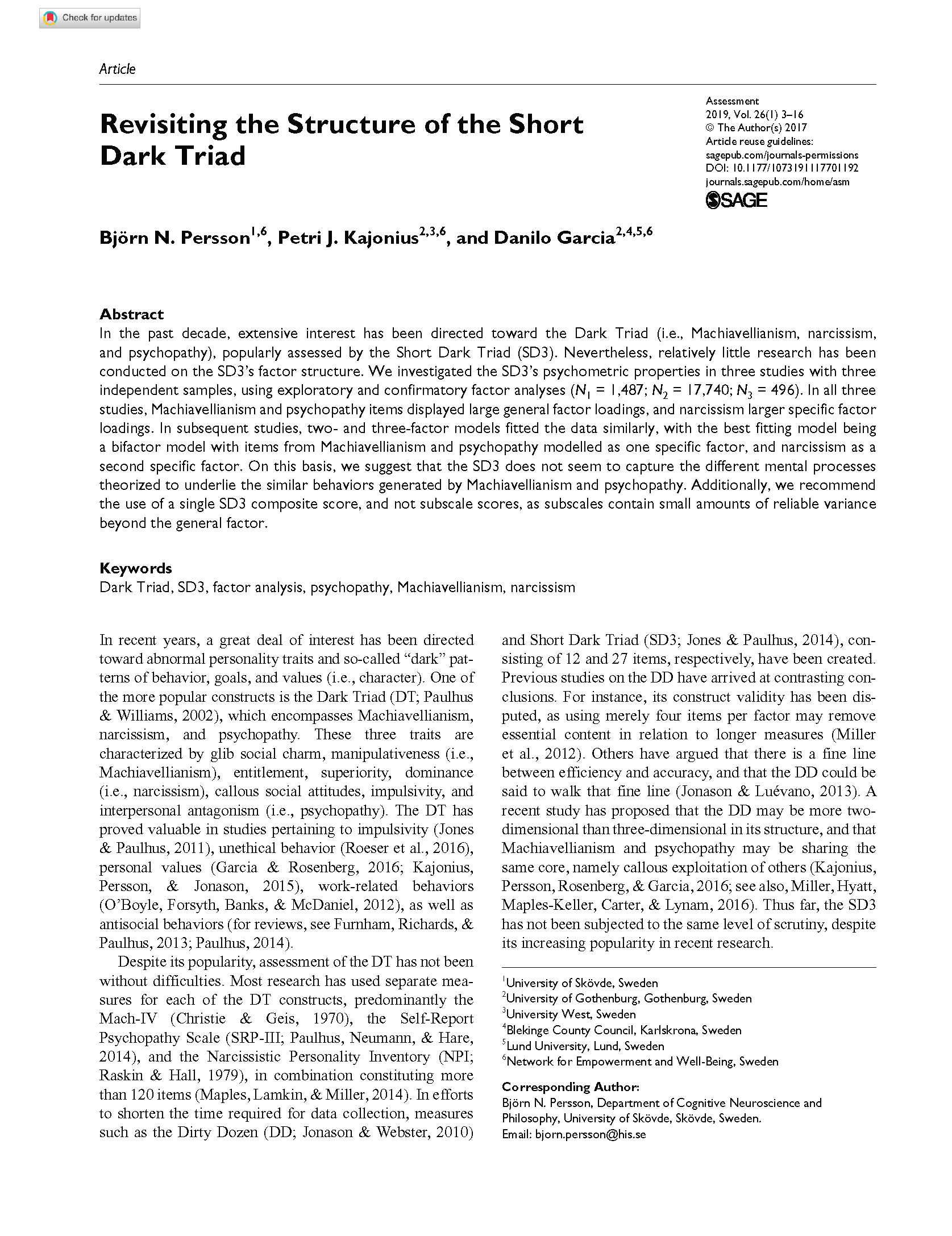
Revisiting the Structure of the Short Dark Triad

We investigated the SD3’s factor structure in three independent samples using exploratory and confirmatory factor analyses. Machiavellianism and psychopathy items showed large general factor loadings while narcissism loaded more on a specific factor. A bifactor model fit best, and we recommend using the SD3 composite score rather than subscale scores.

April 2017 · Björn N. Persson, Petri J. Kajonius, Danilo Garcia
Paper preview

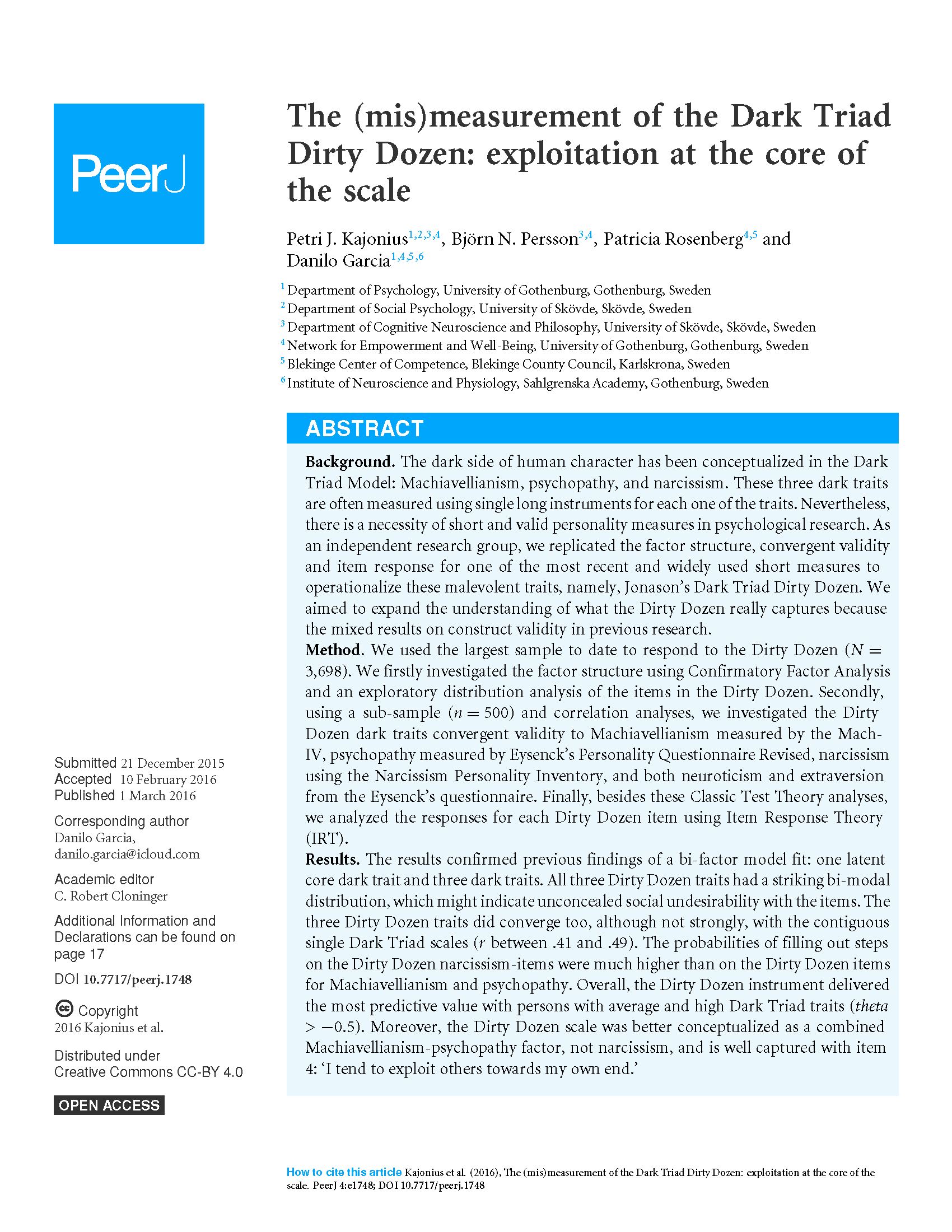
The (Mis)measurement of the Dark Triad Dirty Dozen: Exploitation at the Core of the Scale

We replicated the factor structure and item response properties of the Dark Triad Dirty Dozen (DD) in a sample of 3,698. Results confirmed a bi-factor model, but suggest the DD is best understood as a combined Machiavellianism-psychopathy factor, with its core captured by a single exploitativeness item.

March 2016 · Petri J. Kajonius, Björn N. Persson, Patricia Rosenberg, Danilo Garcia
Paper preview

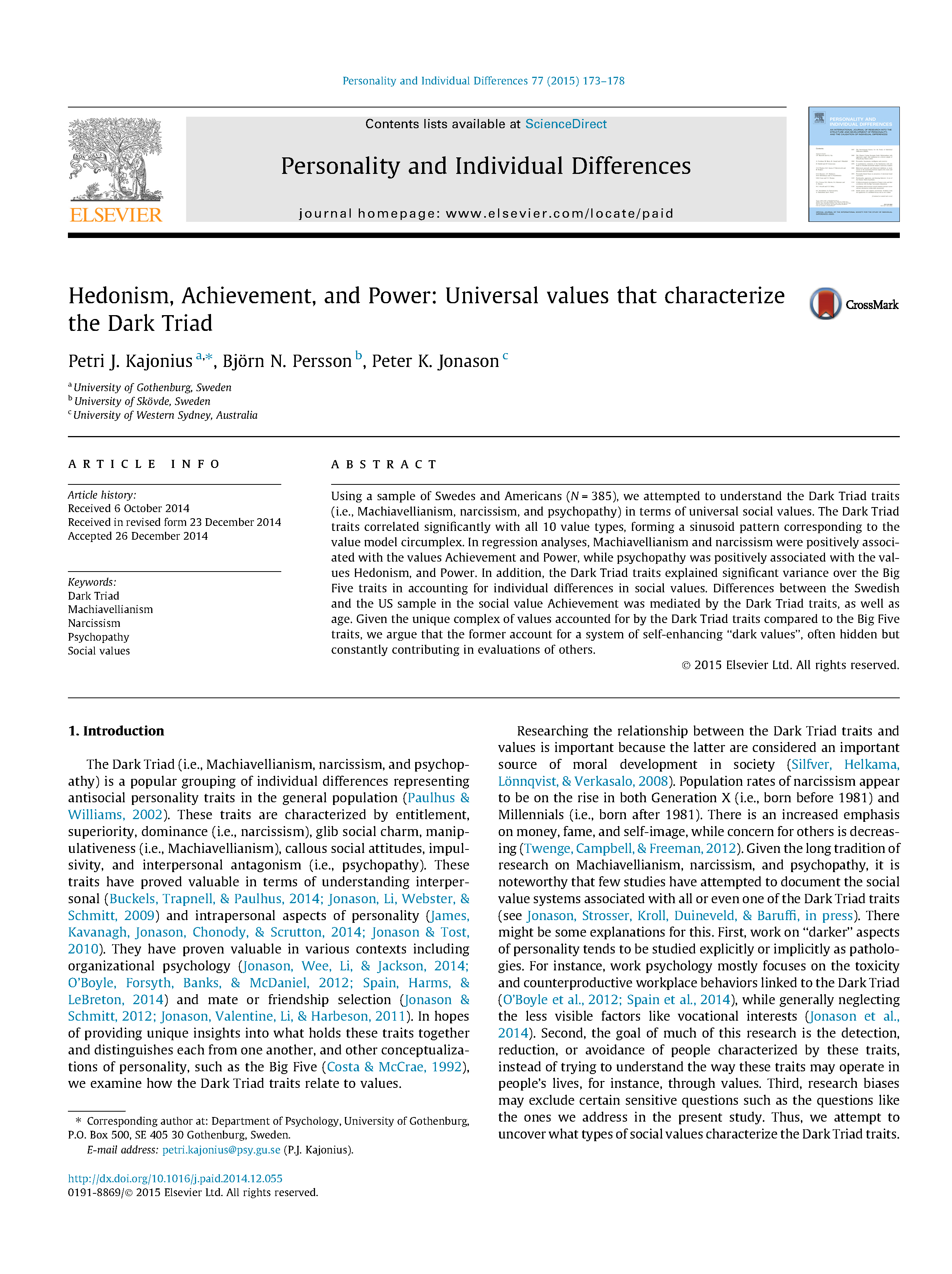
Hedonism, Achievement, and Power: Universal Values That Characterize the Dark Triad

Using a sample of Swedes and Americans (N = 385), we examined how Dark Triad traits relate to Schwartz’s 10 universal value types. Machiavellianism and narcissism were linked to Achievement and Power, and psychopathy to Hedonism and Power. The Dark Triad traits explained unique variance in social values beyond the Big Five.

January 2015 · Petri J. Kajonius, Björn N. Persson, Peter K. Jonason
Paper preview